
Why Do I Feel Anxious When Nothing Is Actually Wrong?

“This doesn’t make any sense.”
That was the thought running through my head as I got ready to meet a friend for tea.
The café was only five minutes from my house. I wasn’t running late, and I was genuinely looking forward to seeing her. So why was my heart racing? Why did I suddenly feel short of breath when nothing stressful was actually happening?
When we arrived, we waited for a booth to become available. Normally, I would have waited for the waitress to finish wiping down the table before sitting down.
Instead, I slid right into the booth while she was still cleaning it.
It was such a small moment, but afterward I remember thinking, “Why did I do that?” It wasn’t like me at all.
Maybe you’ve experienced something similar.
Perhaps your heart starts racing before leaving the house, even for something you’re looking forward to. Maybe you feel anxious driving somewhere familiar or find yourself rushing through situations that don’t really require urgency.
If you’ve ever wondered, “Why do I feel anxious when nothing is actually wrong?” you’re certainly not the only one.
In fact, I’ve been asking myself the very same question.
When Your Body and Mind Aren’t on the Same Page
One of the biggest surprises of midlife is discovering that your body can react to stress even when your mind feels perfectly calm.
Life may have become quieter. The children are grown, work has settled down, and your calendar isn’t nearly as hectic as it once was. Yet your heart races, your breathing changes, and your body behaves as though it’s preparing for something important.
That disconnect can feel incredibly confusing until you understand what’s happening beneath the surface.
Your Brain Learned to Stay Ready
Think about everything you’ve managed over the past few decades.
You may have raised children, built a career, cared for aging parents, supported family members, managed a household, or spent years making sure everyone else’s needs were met before your own.
For a long time, staying alert wasn’t simply a habit. It was a very practical way of navigating life.
Our brains are remarkable at learning from repetition. The more often we experience something, the more efficiently the brain prepares us for it the next time.
If life required you to stay organized, anticipate problems, and always think three steps ahead, your nervous system became exceptionally good at doing exactly that.
The challenge is that those patterns don’t always disappear the moment life becomes calmer.
Why Menopause Can Make It More Noticeable
Hormones add another piece to the puzzle.
Estrogen influences far more than our reproductive system. It also supports several of the brain chemicals involved in mood, resilience, and the body’s response to stress.
As estrogen declines during perimenopause and postmenopause, many women notice they’re more sensitive to situations that never used to bother them. Small changes can feel bigger, everyday responsibilities can feel heavier, and physical symptoms such as palpitations or shortness of breath may appear more easily than they once did.
Understanding this doesn’t make the symptoms disappear overnight, but it often replaces confusion with clarity.
The Symptoms Are Real
When your brain senses that it’s time to be alert, your body responds exactly as it was designed to.
Your heart beats faster. Your breathing becomes shallower. Your muscles prepare for action. You may notice butterflies in your stomach, tingling sensations, or that frustrating feeling of not being able to take a full breath.
Those sensations are real.
The reassuring part is knowing they don’t always mean you’re in danger.
For me, something interesting happened once my friend and I settled into conversation. Within a few minutes, every symptom disappeared. My surroundings hadn’t changed, but my nervous system had received a different message.
It finally realized that everything was okay.
Helping Your Nervous System Feel Safe Again
One of the things I find most encouraging is that the brain continues learning throughout our lives.
Just as years of responsibility taught your nervous system to stay alert, repeated experiences of safety can gradually teach it something new.
That might mean eating regular meals instead of skipping lunch, taking a walk outside, slowing your breathing for a minute or two, laughing with a friend, or simply sitting quietly with your morning coffee before reaching for your phone.
These moments may seem ordinary, but they send your brain a powerful message that life doesn’t require constant vigilance.
A Tool I Keep Coming Back To
Because these feelings can catch me off guard, I created something I now keep within easy reach.
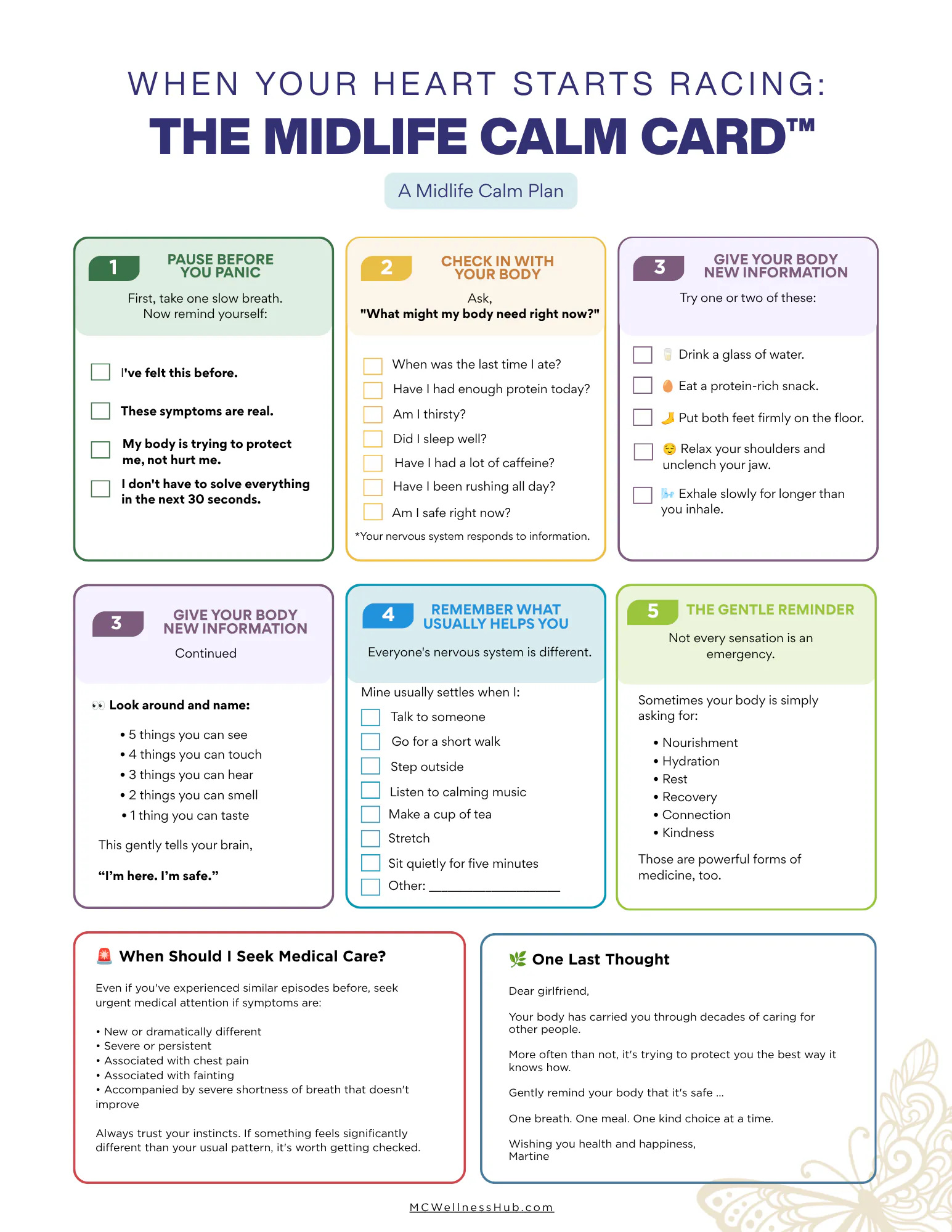
My Midlife Calm Card is a simple printable guide (one I keep on my phone) that reminds me what to do when my body suddenly shifts into high alert. It doesn’t replace medical care, but it helps me slow down, check in with myself, and remember the steps that usually help me feel grounded again.
👉 You can access it instantly anytime in my Your Midlife Mojo Tools library.
Sometimes having a gentle reminder is all we need in the moment.
When Should You Talk With Your Healthcare Provider?
Heart palpitations, shortness of breath, dizziness, chest discomfort, or tingling sensations should never be automatically dismissed as anxiety or menopause.
Similar symptoms can occur with thyroid disorders, anemia, blood sugar changes, heart rhythm problems, medication side effects, and other medical conditions. If these symptoms are new, becoming more frequent or severe, or accompanied by chest pain, fainting, or persistent shortness of breath, it’s important to seek medical evaluation promptly.
Once other medical causes have been ruled out, many women find it reassuring to understand that their nervous system may still be part of the picture.
One Last Thought
One of the unexpected gifts of writing MC Wellness Hub has been realizing how many of the questions I ask myself are the very same questions you ask too.
For a long time, I assumed these episodes meant I simply needed to “handle stress better.” Now I understand that my nervous system spent decades learning how to keep me prepared for whatever came next.
These days, when that familiar wave of anxiousness appears, I try something different. I pause, take a slow breath, and gently remind myself that I’m safe. Then I give my body a few minutes to catch up with what my mind already knows.
Little by little, those moments are becoming easier.
I have a feeling they will for you too.
Wishing you health and happiness,
Martine
🌿Midlife wellness Tip
The next time you notice your heart racing, pause before assuming the worst. Ask yourself, "Am I safe right now?" Then take a few slow breaths and give your nervous system a chance to settle. Sometimes that gentle pause is exactly what your body needs.
Keep Exploring
Why Do Anxiety and Digestive Problems Show Up Together in Midlife?
Why Does My Brain Wake Up at 3 A.M.?
Why Am I So Irritable Lately? Is It Really Hormones?
Why You Need More Recovery (Not Just More Sleep) During Menopause
How To Create a Self-Care Plan That Actually Fits Your Midlife Life
References
- McEwen BS. Protective and damaging effects of stress mediators. New England Journal of Medicine. 1998;338(3):171–179.
- Charmandari E, Tsigos C, Chrousos G. Endocrinology of the stress response. Annual Review of Physiology. 2005;67:259–284.
- The Menopause Society. The 2022 Hormone Therapy Position Statement of The Menopause Society. Menopause. 2022;29(7):767–794.
- Porges SW. The Polyvagal Theory: Neurophysiological Foundations of Emotions, Attachment, Communication, and Self-Regulation. W.W. Norton & Company; 2011.
- Arnsten AFT. Stress signalling pathways that impair prefrontal cortex structure and function. Nature Reviews Neuroscience. 2009;10(6):410–422.
A Quick Note:
The information shared on MC Wellness Hub is for educational purposes only and is not a substitute for personalized medical advice, diagnosis, or treatment. Always consult your healthcare provider before making changes to your diet, supplements, medications, or healthcare plan.

Wondering Why Your Waistline Changed?
Explore the clues behind midlife belly fat with this free guide.